
Shackelford Probation and Parole Compared
Probation, formally called community supervision in Texas, is ordered by a court instead of or after a jail term. A person can begin probation without ever entering the Texas prison system. Parole is a conditional release from a Texas Department of Criminal Justice sentence. Mandatory supervision is another state-prison release path based on statutory rules. Both parole and mandatory supervision are administered after release by the TDCJ Parole Division.
The source record reveals which system applies. A Shackelford court judgment and the Jones and Shackelford County Community Supervision and Corrections Department identify probation. A TDCJ record, a Board decision, and a Parole Division assignment identify parole or mandatory supervision. The Sheriff's booking-out record establishes when county custody ended, but it does not substitute for either supervision record.
| Question | Probation | Parole or mandatory supervision |
|---|---|---|
| Who orders or authorizes it? | A trial court | Texas law and the Board of Pardons and Paroles process |
| Who supervises locally? | Jones and Shackelford County CSCD | TDCJ Parole Division, Abilene District Parole Office |
| Best starting record | Court judgment or supervision order | TDCJ offender, Board, and release records |
| Does it prove a jail exit? | No | No, not until actual release is recorded |
- Parole
- Conditional community release before a state sentence reaches flat discharge.
- Probation
- Court-ordered community supervision managed by a local CSCD.
- Mandatory supervision
- A statutory TDCJ release category that applies only when eligibility rules are met.
- Discharge
- The formal end of custody or supervision, shown by the responsible agency's record.
Verify Shackelford Post-Release Supervision
Begin with the legal event, not a guess based on where the person was last seen. County bond release can occur with no probation. A probation order can follow a local case without a state-prison release. A favorable parole vote can exist while the person remains incarcerated.
- Match the full name with a date of birth, SID, TDCJ number, or case number when available.
- Search the combined Shackelford County and District Clerk case for a judgment or community-supervision order.
- For state custody, use the Board offender review and decision gateway and the current TDCJ offender record.
- Contact the correct local office. Ask the office to confirm only information it may lawfully disclose.
- Obtain the actual release or discharge record before stating that custody or supervision ended.
TDCJ identifies cases for initial parole review about six months before eligibility and later reviews about four months in advance. An institutional parole officer prepares the case summary. A three-person panel votes in sequence, and two matching votes produce the result. These steps explain a review status, not a physical exit.
The Board says ordinary parole and mandatory-supervision consideration does not use a formal offender hearing. Therefore, there is no ordinary inmate-by-inmate hearing calendar to consult. Public Board meeting notices are different. The official parole panel FAQ is the right source for that distinction.
Shackelford Supervision Office Split
Local supervision divides between two offices. Jones and Shackelford County CSCD handles probation ordered by courts in the participating counties. The Albany contact is at 225 South Main Street, Albany, Texas 76430, with phone 325-762-2629. Published office hours are Monday through Thursday, 7:00 a.m. to 5:00 p.m. The department also has an Anson office.
State parole and mandatory supervision route through TDCJ's Region V Abilene District Parole Office. The office is at 5241 West Stamford Street, Abilene, Texas 79603, with phone 325-672-1495. TDCJ's county cross-reference maps Shackelford to this office. It is not the probation department and is not the county jail.
Jones and Shackelford County CSCD
225 South Main Street
Albany, TX 76430
325-762-2629
Parole and mandatory supervision
TDCJ Abilene District Parole Office
5241 West Stamford Street
Abilene, TX 79603
325-672-1495
The CSCD contact page and TDCJ Region V directory should be checked before travel because agency details can change. Call with a specific reason and reliable identifiers.
Shackelford Parole Decisions Aren't Releases
Board results use codes that describe decisions and conditions. An FI code is an approval form with timing or program variations. RMS is another approval path. NR means denial with a later review, SA means serve all, and DMS can set a later mandatory-supervision review. The Board vote-options page defines the current codes.
An approval date is not the release date. Program completion, detainers, release planning, records checks, and other lawful requirements may remain. Review and Release Processing can provide pre-release status at 512-406-5202. After the planned date, verify the completed TDCJ release record and any IVSS event.
The parole eligibility date is also different. Texas Government Code Section 508.145 contains several formulas based on the offense, offense date, sentence, and statutory category. Eligibility only opens consideration. It does not promise approval or predict a day outside custody.
For many ordinary Texas cases, calendar time plus good-conduct time must equal one-fourth of the sentence or 15 years, whichever is less, before parole eligibility. Covered Article 42A.054 cases generally require actual calendar time equal to one-half of the sentence or 30 years, whichever is less, with special minimums and exceptions. Other statutes impose longer periods or no parole eligibility. Texas has no general state-prison 85 percent rule. The exact offense date and controlling subsection must be checked rather than applying a shortcut.
Mandatory supervision has its own eligibility exclusions under Government Code Section 508.149 and its own threshold under Section 508.147. Good-conduct time can affect a calculation without proving good behavior outside custody or shortening the sentence shown in the judgment. Lost credits, consecutive sentences, detainers, new sentences, Board action, and record corrections can change the path. The Shackelford projected release date lookup separates those calculations from completed release.
Shackelford Violations and Wanted Status
Supervision conditions are set by the court or state authority. They can include reporting, travel limits, treatment, fees, testing, and offense-specific terms. The controlling order and supervising officer are the proper sources. A violation allegation does not by itself establish a final revocation.
An absconder is a supervised person whose location or reporting status has become a violation issue. A warrant may lead to arrest and a separate revocation process. The Board does conduct administrative due-process hearings for alleged parole or mandatory-supervision violations, but those proceedings concern someone already released. They are not ordinary initial parole reviews.
The Sheriff publishes a Most Wanted section and accepts tips through 24-hour dispatch at 325-762-9555. That local list is not a TDCJ parole-absconder database. A name's presence is a specific county lead; absence proves nothing about warrants, release, or compliance. Do not approach a wanted person. Send current information to law enforcement.
Confirm Shackelford Supervision Discharge
Supervision ends through the authority that imposed or administered it. For probation, seek the court's discharge or termination order and confirm the CSCD record. For parole or mandatory supervision, seek TDCJ's completed discharge information. Reaching a projected date, finishing a program, or disappearing from a public search does not prove discharge.
A narrow records request should identify the person, case or TDCJ number, and the precise record sought. Ask for the completed discharge date, authority, and status. Texas public-record law may permit access to some information while requiring other material to be withheld. An expunction or nondisclosure order can also affect access and should not be guessed from a blank search result.
The county release event remains a separate record. The Shackelford County released inmate search explains how the Sheriff's booking-out entry and the combined Clerk's order work together. One proves the physical county exit; the other explains the court authority.
Shackelford Parole Review Source
The Texas parole review process is the source for how case review moves from identification through interview and panel voting.
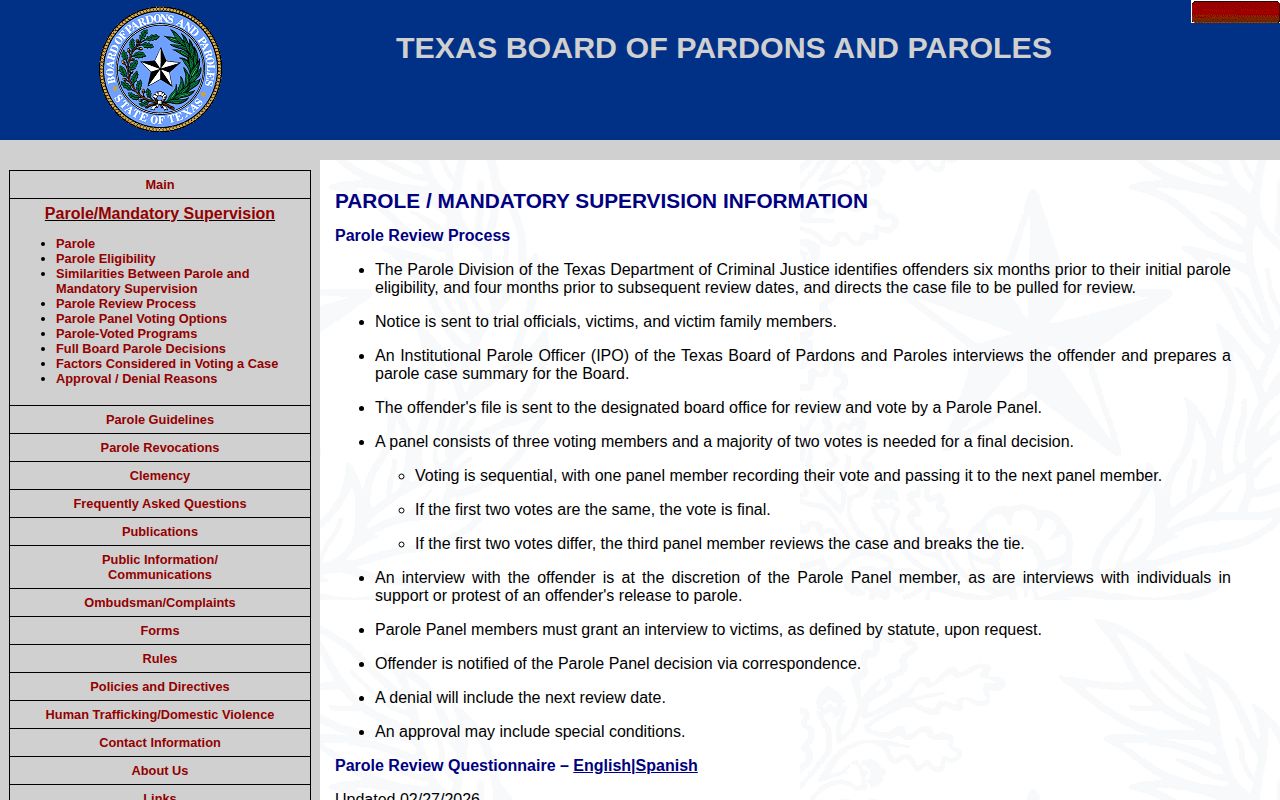
This captured official page supports the state-review workflow. It does not show that a named person has been released or assigned to a Shackelford-area office.
Ordinary Texas parole consideration does not use a public hearing calendar. The Board reviews the file and votes, while a revocation hearing is a different process for someone already released under supervision. To check a pending case, use the Board gateway or call parole status at 844-512-0461. Record the displayed decision code and date without turning the review date into a release date. After approval, conditions, a detainer, certificate preparation, and release planning may still remain. Actual exit should be confirmed through TDCJ records and the relevant IVSS event. This distinction matters in Shackelford County because the Abilene parole office cannot convert an approval code into proof that prison custody ended.
Public Record Search
Sponsored Results