
Shackelford Projected Versus Actual Release
A projected release date is a calculation made while a person remains incarcerated. TDCJ defines and calculates that field from the offense, sentence, start date, statutory category, credits, and other record data. It can move. It is not a promise that the person will walk out on that day, and it is not the same as an actual release date recorded after custody ends.
Texas state-prison records also use parole eligibility and scheduled release dates. Eligibility marks when a case can be considered under the governing law; it does not mean the Board approved release. A scheduled release date appears later, after a favorable decision and records or certificate processing. Even then, a detainer, audit, changed decision, or corrected record can affect the plan. Actual release is the completed event documented by TDCJ.
A person held before trial in Shackelford County Jail generally has none of these computed prison dates. Release depends on the court, bond, case disposition, and other holds. The live jail inquiry displays current booking data but no release-date field. Ask the Sheriff about the exact booking and check the combined clerk's case for the controlling order.
Find a Shackelford Projected Release Date
Begin with custody type. A county booking, state-prison sentence, and federal sentence use different calculators and records. For TDCJ, an identifier is safer than a name alone. The public search accepts a seven-digit TDCJ number or SID number as well as first and last name, gender, and race.
- Check the Shackelford court case to learn whether the person is pretrial, serving county time, or committed to TDCJ.
- For current state custody, open the TDCJ Inmate Search and use the TDCJ or SID number when available.
- Open the matching record and compare identifiers, committing county, court, and offense before reading any date.
- Record each label separately: Projected Release Date, Parole Eligibility Date, and any Scheduled Release Date and Location.
- For a missing or historical record, contact TDCJ by email, telephone, or public-information request. For county time, ask the Sheriff and clerk.
TDCJ warns that its public search includes only people currently incarcerated in a TDCJ facility. It updates on working days, and displayed information is at least 24 hours old. A record's disappearance can follow release but cannot prove it. Email requests can return historical incarceration and projected-date information when supplied with a full name plus TDCJ number, or an exact birth date and county of conviction when the number is unknown.
Telephone locator help is available at 936-295-6371 or 800-535-0283 from 8 a.m. to 5 p.m. weekdays. Have the identifier or exact date of birth ready. For an actual completed discharge, request incarceration history and the actual release date and type through TDCJ's Public Information Act process.
Texas Good Time and Shackelford Dates
Texas Government Code §498.003 treats TDCJ good conduct time as a privilege, not a right. It generally affects eligibility for parole or mandatory supervision rather than reducing the sentence itself. Credits depend on the person's statutory and classification status and can be lost. This is why a simple arithmetic deduction from the sentence is unreliable.
For mandatory-supervision-eligible offenses committed before September 1, 1996, a projected date may reflect the point when calendar time plus good time reaches the sentence if parole has not already occurred. For later eligible cases, reaching that threshold also requires discretionary mandatory-supervision approval. A denial can cause the projected field to recalculate toward maximum expiration; later approval can move it again. Ineligible cases generally project to maximum expiration, where flat calendar time controls.
Parole follows separate eligibility and Board rules in Government Code §§508.145, 508.147, and 508.149. Texas law does not support importing a universal federal “85 percent rule” into a Shackelford state case. The offense date, offense category, sentence, and Texas statute control. A favorable Board vote is still not a physical release.
Why Shackelford Release Dates Change
A date can change because the inputs or legal stage changed. Compare the new display with the prior record instead of treating movement as an error. When the reason is unclear, ask Classification and Records or use the documented offender-information channel.
| Factor | Possible effect |
|---|---|
| Credit earning or loss | Changes the time calculation used for an eligible case. |
| Mandatory-supervision decision | Approval or denial can move the projection, sometimes toward maximum expiration. |
| Parole Board action | A favorable or unfavorable decision changes the release path, but approval alone is not exit. |
| Record audit or correction | Sentence, offense, credit, or identifier corrections can produce a new calculation. |
| Detainer or consecutive sentence | May delay community release or route the person into other custody. |
| Court order | An amended judgment or other valid order can change the legal basis for confinement. |
The Board identifies cases before eligibility, an institutional parole officer prepares the review material, and a three-member panel votes until two matching votes decide the case. The decision search can show stage, last decision and date, and a future review. It is not an actual-release register. Review and Release Processing at 512-406-5202 is the proper channel after a favorable vote when release processing is at issue.
Shackelford County Jail Time Calculations
Texas Code of Criminal Procedure Article 42.032 permits a county sheriff to grant limited good-conduct commutation for certain county-jail sentences. The authority is permissive and tied to local administration; it is not evidence that Shackelford applies a fixed automatic rate. No county-specific good-time policy was found. Ask the Sheriff for the calculation used in the identified sentence and compare it with the judgment and jail-credit finding.
Article 43.13 addresses discharge timing for county sentences that expire on a Saturday, Sunday, or legal holiday. Its rules provide legal context, but they do not establish a standard release hour, exit door, or weekend practice at the Law Enforcement Center. Shackelford publishes none of those operating details. Current procedure must come from the jail.
Pretrial time works differently. A bond payment, personal bond order, or dismissal may authorize release, but staff still must clear other holds and complete the booking-out process. The LEC bond kiosk accepts certain cash bonds at all hours, with a published $4 cash service fee, yet payment time cannot be substituted for release time.
TDCJ Scheduled Shackelford Releases
TDCJ's release process separates calculation, approval, and physical exit. After an appropriate favorable decision, records staff audit the sentence and prepare the release certificate. Scheduled Release Date and Scheduled Release Location may then appear in a current record. Those fields can change without notice, and the release location need not be a prison in Shackelford County.
No TDCJ unit is physically identified in Shackelford County. A person sentenced by a Shackelford court can be held anywhere in the statewide system, and the release plan follows TDCJ procedures. The Abilene District Parole Office, Region V, serves Shackelford for parole and mandatory supervision after release. Probation belongs to the separate Jones and Shackelford County CSCD.
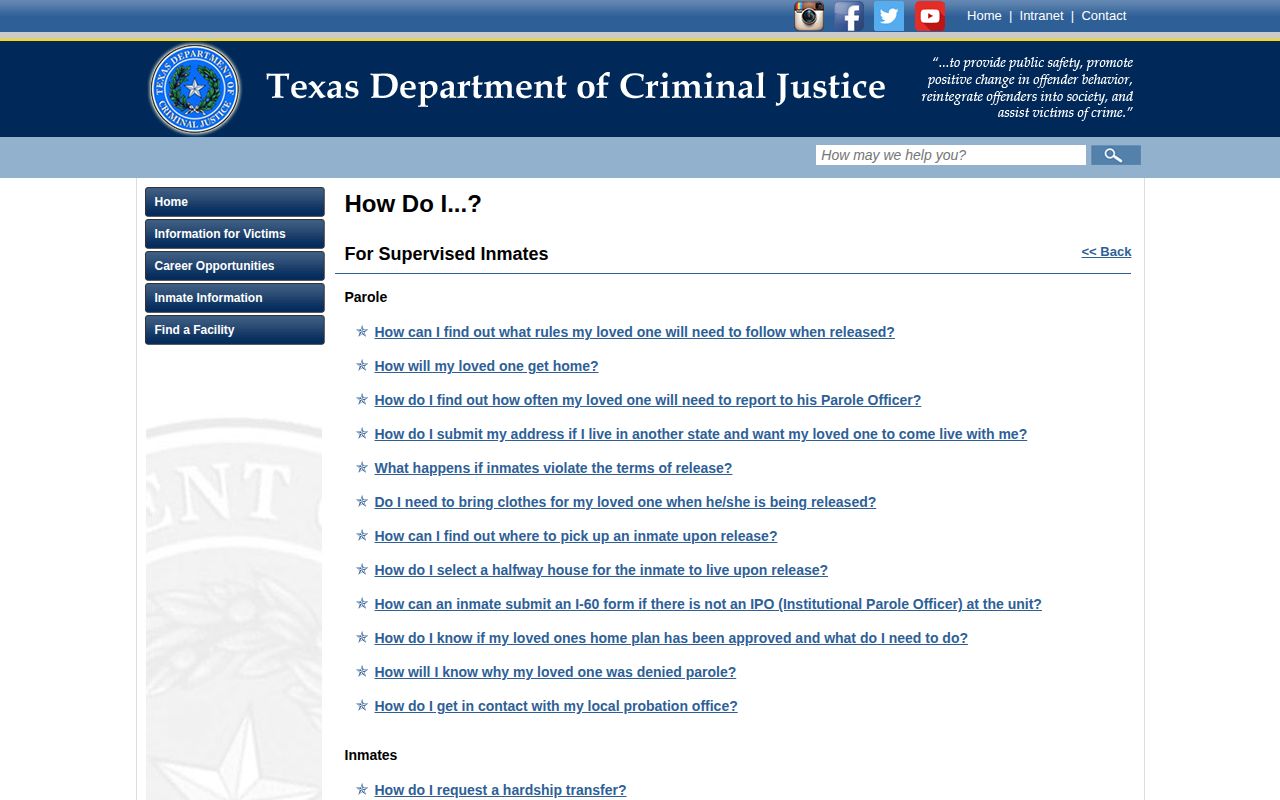
The official TDCJ release information shows the statewide process and practical release framework.
Confirm a Shackelford Actual Release
Use notification as an alert, then preserve the agency record. County custody events now route through IVSS-Counties rather than old generic Texas VINELink instructions. The portal can accept a name, DOC ID, SID, jail ID, or permanent booking number. A person who leaves custody may disappear from its search, so a no-result screen does not confirm release.
TDCJ prison, parole, and mandatory-supervision notifications use the separate TDCJ IVSS service. It can issue notices for release, discharge, Board action, and later parole-warrant events. The VINELink Inmate Search page explains the two current Texas systems and why an alert confirmation should be kept.
For county jail release, call Sheriff's administration at 325-762-9500 or 24/7 dispatch at 325-762-9555. Ask whether the identified booking closed, the actual date and time, the authority or type, whether another hold existed, and whether the person transferred. Follow the call with a written booking-out request. For TDCJ, ask for the actual release or discharge record rather than quoting the last projection.
The written state route is TDCJ's Public Information Act office. Requests may be sent through its web form, by email to PIA@tdcj.texas.gov, by hand delivery, or by mail to TDCJ Public Information Request, P.O. Box 4017, Huntsville, TX 77342. Identify the person and ask for incarceration history, actual release or discharge date, release type, unit, and available certificate or summary. TDCJ's published copying guidance lists ten cents per page for fewer than 50 pages plus postage, with possible labor and overhead for larger productions. If an estimate exceeds $40, the requester must respond within ten days. Asking for electronic records and an estimate keeps the request focused.
A county record requires a different request. Send a narrow booking-in and booking-out request to the Shackelford County Sheriff's Office at 791 U.S. Highway 180 West, Albany, TX 76430, or use its published fax at 325-762-9501. Include the booking number or a tight date range. Ask for the actual exit time, authority, release type, and receiving agency if transferred. Then compare the response with the combined County/District Clerk's order or judgment. The clerk explains why custody could end; the Sheriff's record shows when staff carried out that action.
Never report a projection without its label and retrieval date. A clear note such as “TDCJ displayed a projected date while the person remained in custody” preserves the difference between calculation and fact. If a later scheduled field appears, save it separately. Once the person leaves, replace both estimates with the completed agency record instead of assuming the last date shown became the actual release.