
TDCJ Release Paths
A Shackelford court commitment moves a person from the county jail into the statewide Texas Department of Criminal Justice system. The county booking-out record may say transfer even though custody continues. TDCJ can later release the person on parole, mandatory supervision, or flat discharge. Parole is conditional community release approved by the Board. Mandatory supervision is a statutory form of supervised release for an eligible case. Flat discharge means the prison term ends without a remaining TDCJ supervision term.
A later community exit may occur from a designated releasing unit far from Shackelford County. It should not be described as a release from the local jail. The state actual-release record identifies the completed event. IVSS can supply a status notification, and the TDCJ Parole Division handles supervision. The Abilene District Parole Office serves Shackelford County when an approved release plan places the person in this area.
| Event | Best source |
|---|---|
| Current state custody | TDCJ inmate search |
| Parole review or decision | Board review search |
| Actual release or discharge | TDCJ records and IVSS |
| Local parole supervision | Abilene District Parole Office |
Confirm a TDCJ Release
The TDCJ inmate search includes only people currently incarcerated in a TDCJ facility. Search by the seven-digit TDCJ number or SID when possible. A name search accepts last and first name, with race and sex filters if needed. Compare the county of conviction, court, offense, and identifiers before treating a result as a match.
The detail may show projected release, parole eligibility, and, after approval and records work, a scheduled release date and location. None proves that the person left. TDCJ says information is updated on working days and is at least 24 hours old. A record that disappears is not a stable “Released” result. It calls for historical or actual-release records.
- Search the current-only TDCJ database and confirm the right person.
- Read every date by its exact label. Do not turn projected or scheduled into actual.
- Check Board review status if parole action is relevant.
- After a favorable vote, contact Review and Release Processing at 512-406-5202.
- Confirm the final exit through TDCJ records and IVSS, including release type and unit.
TDCJ Release Record Requests
When a former prisoner no longer appears, use the TDCJ offender-information email route. Supply full name and TDCJ number. If the number is unknown, provide exact birth date or approximate age and the conviction county, and place the person's name in the subject. The no-charge reply can include historical incarceration and offense information. It is useful for narrowing the record, but an actual discharge request should name the completed fields needed.
Submit a Public Information Act request through TDCJ's official PIA channels, at PIA@tdcj.texas.gov, or by mail to TDCJ Public Information Request, P.O. Box 4017, Huntsville, TX 77342. Ask for incarceration history, actual release date, release type, releasing unit, and release summary or certificate if available. TDCJ's general guidance lists copies below 50 pages at ten cents per page plus postage, with possible labor and overhead for larger requests. An estimate over $40 requires a response within ten days.
TDCJ Offender InformationTelephone: 936-295-6371 or 800-535-0283
Weekdays, 8 a.m. to 5 p.m.
Public Information Request
P.O. Box 4017
Huntsville, TX 77342
Read TDCJ Release Dates
Parole eligibility is the first point when the Board may consider a person under the governing statute. It is not a promise of release. A projected release date is a TDCJ Classification and Records calculation based on sentence, offense date, eligibility, and credits. A scheduled date is a later operational field that may appear after a favorable decision and certificate audit. Actual release is the event that closes the prison stay.
- Projected release
- A calculation that may move as legal and record facts change.
- Scheduled release
- A planned date after required approvals and processing, still subject to change.
- Parole
- Conditional community release before sentence expiration under Board authority.
- Discharge
- The end of the custody or supervision term recorded by TDCJ.
Good conduct credit under Government Code section 498.003 is a privilege, not a right. It generally affects eligibility for parole or mandatory supervision rather than shrinking the sentence itself. Lost credits, classification changes, detainers, consecutive sentences, Board action, and corrections can alter a displayed date. Texas has no general state-prison 85 percent rule. Government Code sections 508.145, 508.147, and 508.149 control different eligibility questions and exclusions.
View TDCJ Release Sources
The TDCJ offender-information gateway organizes the official search and contact channels.
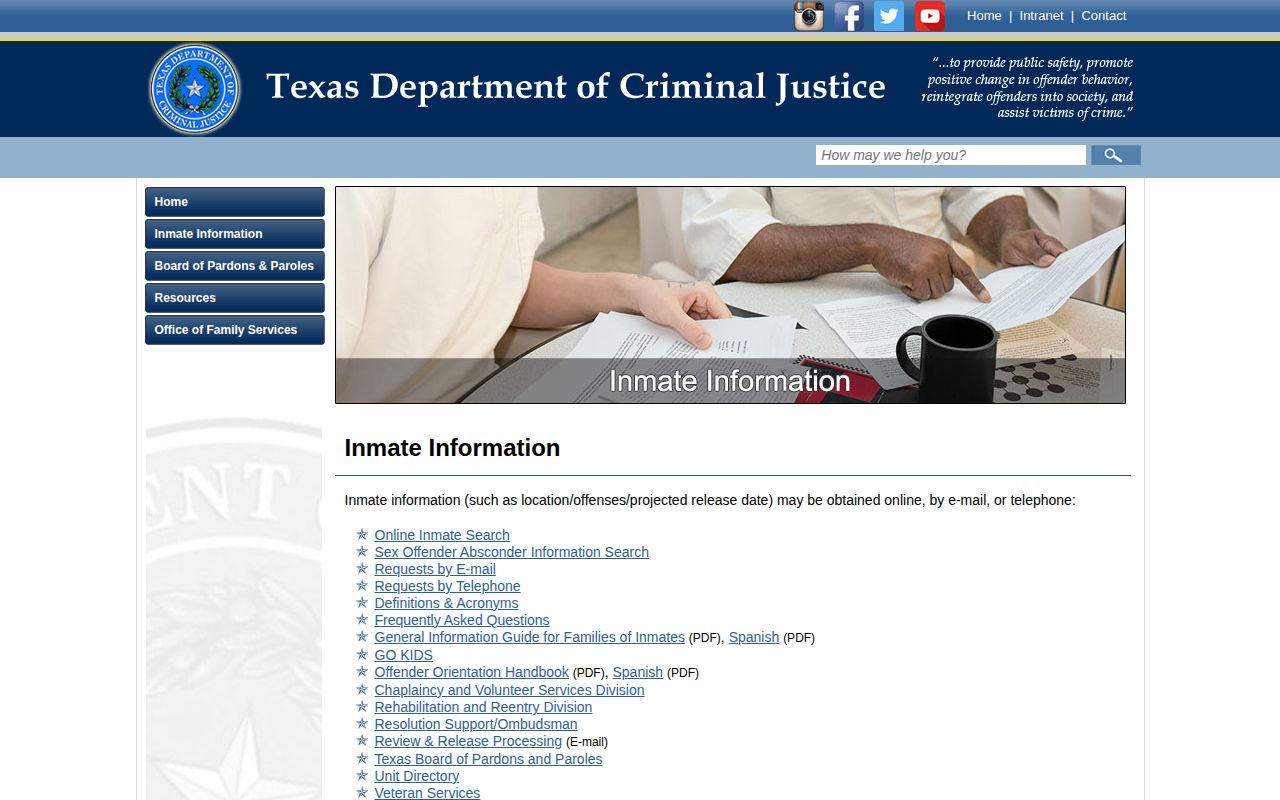
The gateway directs current custody questions to the inmate search while historical release questions require records channels.
TDCJ's parole office county cross-reference assigns Shackelford County to the proper district office.
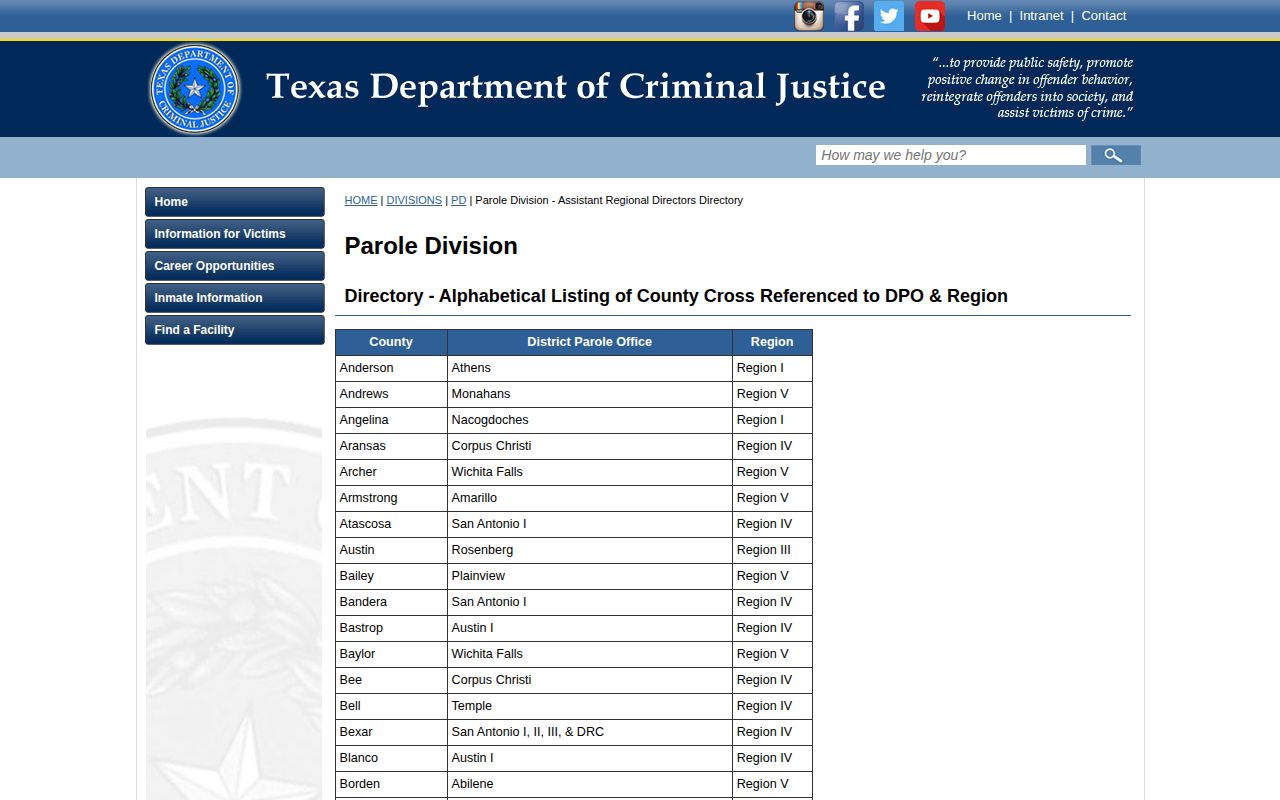
The cross-reference supports office routing after state release. It does not replace the actual-release record.
Texas Government Code Chapter 508 supplies the parole and mandatory-supervision framework.
The statute explains authority and eligibility. It should be applied to the precise offense date and case, not used as a release certificate.
TDCJ Release and Supervision
The Texas Board of Pardons and Paroles decides parole and mandatory-supervision matters. Ordinary parole consideration does not use a formal offender hearing calendar. A three-member panel reviews and votes on the file until two matching votes decide the case. Approval codes can include conditions and timing. Denial codes can set another review or require service of more time. A decision date is never the physical exit time.
After release to Shackelford County, parole or mandatory supervision routes to TDCJ Parole Division, Region V. The Abilene District Parole Office is at 5241 West Stamford Street, Abilene, TX 79603, phone 325-672-1495. Probation is different and routes to Jones and Shackelford CSCD. The Probation and Parole page distinguishes those local paths.
TDCJ IVSS at the state notification portal can provide prison release, discharge, parole, and warrant-event alerts. An alert supports timely notice, but it is not a certified release record. Keep the confirmation and reconcile the event with TDCJ records.
ICE Holds After TDCJ Release
A detainer or another agency's hold can prevent a planned TDCJ exit from becoming an immediate community return. If another custodian assumes the person, the TDCJ record may close while custody continues elsewhere. Read the destination and release type before describing the outcome.
ICE states that an immigration detainer may request notice and a hold for up to 48 hours beyond an ordinary release point so ICE can assume custody. No special Shackelford County ICE contract was verified. This is a conditional route, not a claim about each person leaving TDCJ. When transfer paperwork names ICE, use ICE's locator and information line. For a federal transfer, use the BOP or USMS channel instead.
The same caution applies to a transfer from Shackelford County Jail into TDCJ. The local jail episode ended, but the person entered state custody. Confirm the system boundary first, then use the release record created by the agency that controlled the later exit.
TDCJ Release Day Process
TDCJ says state-prison releases generally occur from 8 a.m. to 5 p.m. on weekdays other than holidays. Government Code section 501.016 can move a weekend or legal-holiday release to the prior workday and requires a release certificate. These rules govern TDCJ, not Shackelford County Jail bond processing.
The state process can provide clothing and a bus ticket to the station nearest an approved residence, while family may pick up at the release site. Government Code section 501.015 provides gate checks for some parole, mandatory-supervision, or flat-discharge releases, but state-jail inmates do not receive the same payment. Confirm the releasing unit and current arrangement before travel.
A planned pickup does not prove release. Detainers, certificate work, corrections, or other action can change the date or destination. Read the completed release certificate and IVSS event after processing. Confirm the Abilene parole route separately from the releasing unit.